
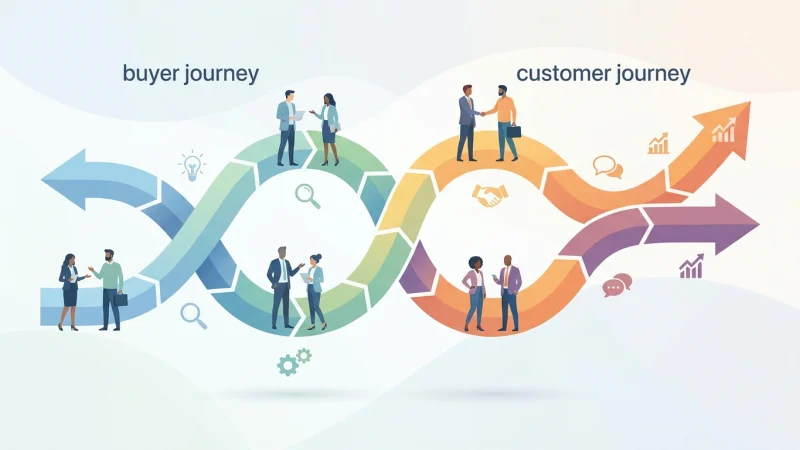
73% of B2B companies create journey maps, but only 29% use them to drive actual business results. That’s quite a gap, isn’t it? This lack of application often leads to missed opportunities for revenue and increased customer churn. Today, you’ll learn a framework that not only bridges this gap but also distinguishes between buyer and customer journeys, a difference most B2B leaders overlook. You’ll walk away with a complete 7-stage framework to revamp your approach and improve your bottom line. Ready to dive in?
What is B2B Customer Journey Mapping (And Why It’s Different from B2C)
Most resources out there mix up B2B and B2C journey mapping, but they’re not the same. At its core, B2B customer journey mapping outlines the various stages and touchpoints a business buyer goes through before making a purchase decision. Unlike B2C, where transactions are generally straightforward, B2B deals involve more complex decision-making processes, multiple decision-makers, and longer sales cycles.
For instance, a B2C journey might involve a single consumer interacting with a brand via social media and the company’s website. On the flip side, a B2B journey involves multiple influencers and decision makers engaging across several touchpoints such as webinars, whitepapers, and personalized emails.
|
Aspect |
B2B Journey Mapping |
B2C Journey Mapping |
|
decision-makers |
Multiple (average 6.8 decision-makers) |
Single or family unit |
|
Decision Timeline |
Months to years |
Minutes to days |
|
Touchpoints |
Webinars, whitepapers, emails |
Social media, retail, e-commerce |
Why do traditional mappings fail in B2B? Simple: they don’t account for the intricate web of interactions and the long decision timelines. Most fall into the trap of applying a B2C template to a B2B context, leading to irrelevant insights and missed opportunities. It’s like trying to fit a square peg in a round hole.
Customer Journey vs Buyer Journey: The Critical Distinction B2B Teams Miss
Here’s a common pitfall: B2B teams often merge the concepts of buyer and customer journeys, treating them as one continuous path. This oversight can be costly. The buyer journey ends at the point of purchase, it’s the prelude, if you will. The customer journey, however, continues beyond the sale, focusing on retention, satisfaction, and advocacy.
By combining the two, companies can lose sight of post-purchase engagements that are important for building long-term relationships. Failing to nurture these post-purchase stages can kill retention rates, with dissatisfied customers 91% less likely to purchase again.
Think about it: the buyer journey is about convincing someone to buy; the customer journey is about convincing them to stay. Blending these stages means ignoring different needs, expectations, and touchpoints that define each phase.
The 7-Stage B2B Customer Journey Framework (Pre + Post Purchase)
This isn’t just another framework, it’s a complete look at the entire lifecycle from initial engagement to long-term loyalty. Here are the seven stages:
- Awareness
- Consideration
- Decision
- Purchase
- Onboarding
- Retention
- Advocacy
Each stage requires specific decision-makers involvement, and identifying these roles can significantly improve your marketing automation efforts. For example, during the Decision stage, your sales team and technical advisors should be front and center, ensuring that your prospects have all the information they need to make a confident purchase.
|
Stage |
decision-makers |
Touchpoints |
KPIs |
|
Awareness |
Marketing Team |
Blogs, SEO, Social Media |
Site Traffic, CTR |
|
Consideration |
Sales Reps |
Webinars, Case Studies |
Lead Conversion Rate |
|
Decision |
Sales & Technical Advisors |
Demos, Free Trials |
Close Rate |
|
Purchase |
Sales Reps |
Contracts, Negotiations |
ACV (Average Contract Value) |
|
Onboarding |
Customer Success |
Training, Support Calls |
Time to Value (TTV) |
|
Retention |
Account Managers |
Email Check-ins, Surveys |
Churn Rate |
|
Advocacy |
Marketing Team |
Referral Programs, Reviews |
Net Promoter Score (NPS) |
Track these KPIs diligently. They’re your compass, guiding adjustments and improvements to align with business goals.
B2B Touchpoint Mapping: Identifying Every Interaction Across Multiple decision-makers
The complexity of B2B transactions makes touchpoint mapping important. In this section, the goal is to map every direct and indirect interaction across all decision-makers. These interactions may include website visits and email exchanges as direct touchpoints, while social media mentions serve as indirect ones.
Integration of both digital and offline interactions is important. Consider a touchpoint audit: list all possible interactions and evaluate their effectiveness. This audit identifies gaps and opportunities for improvement.
|
Touchpoint |
Interaction Type |
decision-makers |
|
Website Visit |
Direct |
Prospect |
|
Email Campaign |
Direct |
Lead |
|
Conference Booth |
Offline |
Industry Influencer |
|
Social Media Mention |
Indirect |
Customer |
|
Webinar Participation |
Direct |
Prospect |
Use a decision-makers-touchpoint matrix to visualize these interactions. It helps you see who’s engaging where, so you can improve for conversion and retention. This approach allows for more targeted strategies, particularly in sectors where multiple decision-makers are involved.
Step-by-Step Guide: How to Create Your B2B Customer Journey Map
So, how do you create a B2B customer journey map? Here’s an 8-step guide tailored specifically for complex B2B environments:
- Define Objectives: Know what you want to achieve.
- Assemble the Team: Include members from sales, marketing, and customer success.
- Identify Buyer Personas: Who are your decision-makers?
- Map the Journey Stages: Use the seven-stage framework.
- Collect Data: Use CRM data, surveys, and analytics.
- Validate the Map: Conduct interviews and focus groups.
- Identify Gaps: Use your touchpoint audit.
- Iterate and improve: Continuously refine based on feedback.
Data collection is critical. use CRM and analytics tools to gather insights into customer behavior. Conduct decision-makers interviews to validate assumptions and refine your personas.
B2B Customer Journey improve: Turning Insights into Revenue Growth
Mapping is just the beginning. To really impact your bottom line, you need to improve. Begin with gap analysis techniques to identify discrepancies between your journey map and actual customer experiences. Prioritize changes using an improve matrix that balances quick wins against long-term improvements.
|
Task |
Effort |
Impact |
Priority |
|
Improve Onboarding Emails |
Low |
High |
High |
|
Redesign Website UX |
High |
High |
Medium |
|
Launch Feedback Survey |
Low |
Moderate |
High |
Consider your ROI calculation framework. For instance, if improving your onboarding process results in a 20% faster time to value, that’s tangible ROI. Measure your returns meticulously, focusing both on quick wins and strategic investments.
Real B2B Journey Mapping Examples: 3 Industry Case Studies with Results
Need inspiration? Here are three industry-specific case studies:
SaaS Company Case Study
A SaaS company revamped its customer journey map, focusing on the onboarding stage. By implementing personalized welcome emails and a user-friendly dashboard, they saw a 30% increase in trial-to-paid conversions.
Manufacturing B2B Example
In the manufacturing sector, a company focused on improving the consideration stage by offering virtual plant tours and detailed product comparison guides. This led to a 25% reduction in the sales cycle.
Professional Services Journey
A consulting firm improve its retention stage by scheduling quarterly check-ins. This proactive approach boosted their annual retention rate by 15%.
These examples demonstrate the power of tailoring your journey map to industry-specific challenges. Whether it’s improving MarTech stack integration or improving communication touchpoints, the right changes can yield substantial results.
Conclusion
So, what’s the first step you should take today? Start by reviewing your existing customer journey map. Identify where you’re conflating buyer and customer journeys, and use the insights from this guide to separate and improve them. change confusion into clarity, and watch your ROI grow.
The future of B2B customer journey mapping is here. Will you seize the opportunity or let it pass you by?
FAQ
What is customer journey mapping? Customer journey mapping is the process of visualizing the various stages a customer goes through when interacting with a company. In a B2B context, this includes all stages from awareness to advocacy, helping businesses understand and improve each touchpoint. How to create a B2B customer journey map? Start by defining your objectives and assembling a cross-departmental team. Identify buyer personas and map the journey stages. Collect data via CRM and interviews, and validate your map to ensure accuracy. Use the insights to continuously refine your approach. What’s the difference between B2B and B2C customer journey mapping? B2B journey mapping involves multiple decision-makers, longer decision timelines, and more complex touchpoints compared to B2C. While B2C focuses on individual consumer experiences, B2B requires navigating relationships with several decision-makers. How long does it take to create a B2B customer journey map? Creating a B2B customer journey map can take several weeks to months, depending on the complexity of your business and the level of detail desired. Involving multiple decision-makers and ensuring data accuracy can extend the timeline.