
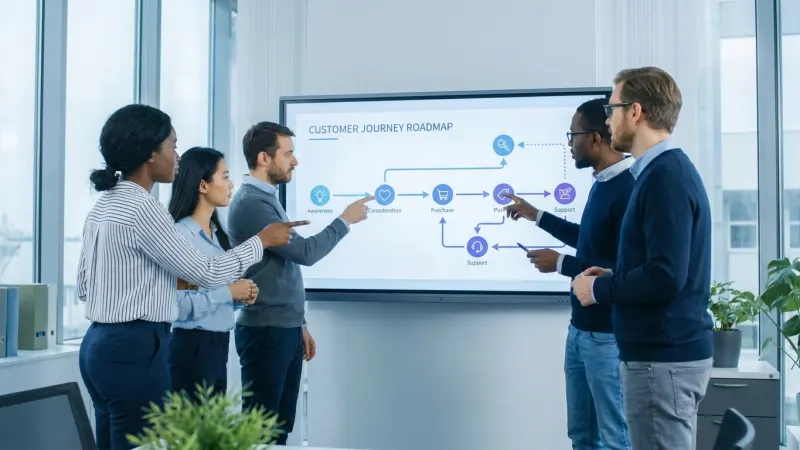
While B2C customers make individual purchase decisions, the B2B buying process is more complex, involving an average of 6.8 decision makers and 27+ touchpoints. Yet, 89% of companies still use journey maps designed for individual buyers rather than committees. This results in missed opportunities and misaligned strategies. If you’re tired of watching competitors win because your mapping is outdated, you’re in the right place. This guide will give you a complete approach to mapping the intricate B2B buying process with a 7-stage framework, a new mapping methodology called IMPACT, and solutions to common roadblocks.
The B2B Multi-decision-makers Challenge: Why Traditional Journey Maps Fail
B2B marketers often struggle with journey maps that work brilliantly for B2C but fall short for committee-driven buying. Consider this: the average B2B purchase involves 6.8 decision makers, and 95% of buyers research independently before engaging a sales team. Traditional single-persona maps miss 73% of actual touchpoints. The ramifications? Lost revenue and misaligned marketing efforts. Let’s break down why B2B is a different beast altogether.
|
Aspect |
B2C |
B2B |
|
Average Decision Makers |
1 |
6.8 |
|
Touchpoints |
12 |
27+ |
|
Research Phase |
Short |
Prolonged |
|
Buying Time |
Quick |
Extended |
The Multi-decision-makers Influence Matrix can help, mapping each committee member’s role and influence. Imagine your sales team engaging a company. Without this matrix, they’re speaking to a wall. With it, they’re talking to the right people at the right touchpoints.
B2B Customer Journey Mapping Fundamentals: Beyond the Buyer Persona
Let’s redefine the basics of customer journey mapping in B2B terms. Unlike B2C, where the buyer journey often revolves around a single persona, B2B requires a decision-makers-centric approach. You’re not just selling to a company; you’re selling to a team with varied priorities. Mapping this effectively could lead to 25% higher conversion rates.
Key differences? B2B journeys blend buyer and customer experiences into a continuous loop. Here’s a framework to clarify:
|
decision-makers Role |
Description |
|
Influencer |
Recommends and advises based on knowledge. |
|
Decision Maker |
Finalizes purchase decisions, often holding budget authority. |
|
End User |
Primary user of the product/service, providing feedback. |
|
Gatekeeper |
Controls information flow within the buying process. |
These roles are pivotal in shaping a B2B journey map. A deeper understanding of each role allows for personalized engagement strategies, significantly improving conversion outcomes.
The 7-Stage B2B Customer Journey Framework (Committee Edition)
For many, mapping a B2B customer journey feels like trying to hit a moving target. But with a structured approach, you can effectively navigate this complexity. Here’s a complete 7-stage framework tailored for multi-decision-makers environments:
- Problem Recognition: Often initiated at multiple departmental levels. Ensure your marketing catches attention across the board.
- Solution Research: Distributed among decision-makers who perform independent research. Your content needs to be findable and relevant.
- Vendor Evaluation: Here, committees scrutinize options, making features like case studies and testimonials gold.
- Consensus Building: The trickiest phase. It requires persuasive content that aligns with various internal priorities.
- Purchase Decision: The formal selection phase. A simplify, compelling offer can sway a hesitant group.
- Implementation: Successful onboarding is key. Here, the end users play a major role in evaluating the solution’s practicality.
- Expansion/Renewal: Nurture relationships to ensure continued partnership and potential upsells.
Each stage presents unique committee dynamics, which are important for tailoring your SEO and marketing strategies.
Multi-decision-makers Touchpoint Mapping: The IMPACT Method
If you’re not capturing and use touchpoints effectively, you’re leaving money on the table. Enter the IMPACT method, your blueprint for navigating multi-decision-makers complexities.
- Identify decision-makers Roles: Recognize the influence each has on the buying process.
- Map Touchpoint Clusters: Categorize these by influence level to prioritize engagement.
- Plot Timing and Sequence: Determine when and how each touchpoint engages decision-makers.
- Assess Content Gaps: Identify and fill content voids that could disrupt the journey.
- Create Trigger Point Alerts: Set alerts for key touchpoints to act proactively.
- Track Committee Progression: Monitor how touchpoints advance committee buy-in.
IMPACT brings precision to your marketing efforts, ensuring you’re speaking to the right people at the right time, In the end, increasing your ROI.
Overcoming Common B2B Journey Mapping Roadblocks
Mapping the B2B journey isn’t just about understanding stages and decision-makers; it’s about overcoming the specific obstacles that come with it. Here are common roadblocks and how to address them:
- Too Many decision-makers: Use the ABM approach to prioritize key influencers.
- Invisible Research Phase: Invest in content that captures interest during this ‘hidden’ stage.
- Consensus Paralysis: help decision-making with simplified, clear information.
- Champion Turnover: Maintain consistent brand engagement to withstand turnover.
- Budget Approval Delays: Provide ROI projections that cater to financial decision-makers.
- Technical Evaluation Complexity: Offer detailed technical documentation to ease this process.
This checklist can save you from the pitfalls common in B2B journey mapping, propelling you towards achieving your revenue goals.
B2B Journey Map Creation: The Step-by-Step Build Process
Creating a B2B journey map isn’t as daunting as it sounds when you break it down into practical steps. Here’s how you can build your map from the ground up:
- decision-makers Research and Interviews: Gather insights directly from decision makers.
- Data Collection Methods: Use analytics and CRM data to inform your map.
- Journey Visualization Techniques: use tools like flowcharts and digital platforms.
- Validation and Iteration Process: Constantly refine with real-world feedback.
- Template and Tool Recommendations: Employ platforms that cater to B2B intricacies.
|
Step |
Recommended Tool/Template |
|
Research |
SurveyMonkey for decision-makers insights |
|
Data Analysis |
Google Analytics for behavioral data |
|
Visualization |
Lucidchart for flowchart creation |
|
Iteration |
A/B Testing with Optimizely |
This step-by-step guide, paired with the right tools and templates, offers a clear path to crafting an effective B2B customer journey map.
Measuring and improve Your B2B Customer Journey
Once your map is in place, measuring its success and making continuous improvements are important. Focus on metrics that reflect committee engagement and consensus velocity.
Consider these key performance indicators:
- Committee Engagement Metrics: Track interaction levels with content and touchpoints.
- Consensus Velocity Tracking: Measure the time taken to reach decision consensus.
- Touchpoint Effectiveness Analysis: Evaluate how each interaction contributes to the overall journey.
- ROI Measurement for Journey Improvements: Assess the financial impact of your mapping efforts.
use this improve priority matrix to focus on areas with the highest potential for improvement. This ensures you’re not just tracking metrics but actively improving your journey map’s effectiveness.
Conclusion
Start today by re-evaluating your current customer journey maps. Conduct a decision-makers role audit using the frameworks outlined, and you’ll uncover gaps that could be costing you deals. Dive into our detailed 7-stage framework to refine your approach further. The future of B2B buying is only going to get more complex, and those who master journey mapping will be best positioned to thrive.
What is customer journey mapping in B2B? Customer journey mapping in B2B involves visualizing the end-to-end process buyers undergo, including all decision-makers interactions. Unlike B2C, it accounts for multiple decision-makers and complex touchpoints, offering insights into buyer behavior and improve marketing strategies. How to create a B2B customer journey map? Start by identifying all decision-makers involved, gather data through interviews and analytics, and visualize each stage using tools like Lucidchart. Validate with real-world feedback to refine the map continuously, ensuring it accurately reflects the B2B buying process. What’s the difference between B2B and B2C customer journey mapping? B2B mapping involves multiple decision-makers, longer sales cycles, and numerous touchpoints compared to B2C. It requires a more complex, committee-focused approach, whereas B2C often deals with individual buyers and simpler journeys. How many touchpoints are in a typical B2B customer journey? A typical B2B customer journey includes 27+ touchpoints. This complexity arises from the involvement of various decision-makers and the need for extensive research, evaluation, and consensus-building phases that characterize B2B purchasing.