
Your marketing team has AI tools, customer data, and enough dashboards to last a lifetime. So why does following up with the right buyer still take three emails and a Slack reminder?
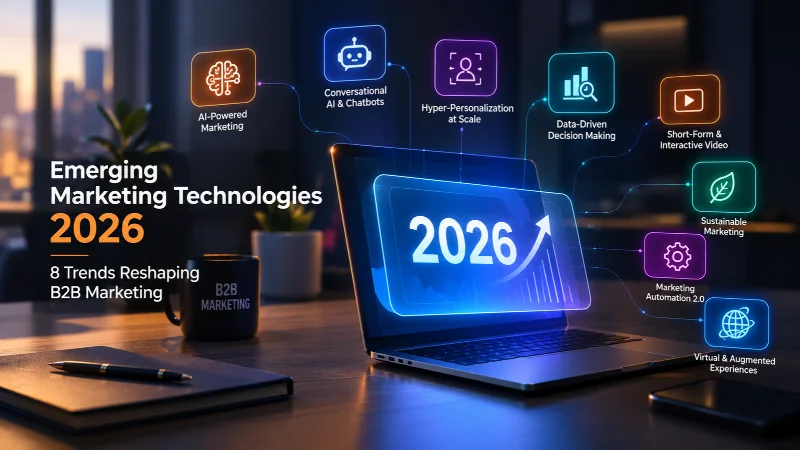
That’s where emerging marketing technologies in 2026 come in. From AI agents that handle repetitive workflows to smarter ways of understanding buyer intent, these technologies are changing how B2B teams work. Here are eight trends worth paying attention to, and what they could actually mean for your marketing team.
Emerging Marketing Technologies: 2026 Priorities at a Glance
The priorities below are editorial recommendations for B2B teams, rather than universal adoption rankings. Investment should depend on data readiness and business needs.
| Technology | Main B2B Marketing Use | 2026 Priority |
| Agentic AI | Workflow automation | High |
| Intent intelligence | Account prioritization | High |
| AI search visibility | Brand discovery | High |
| Revenue intelligence | Pipeline prediction | High |
| Multimodal AI | Content production | Medium-High |
| AI governance | Risk and control | High |
| First-party data | Personalization | High |
| Composable MarTech | Stack orchestration | Medium–High |
1. Agentic Marketing and Autonomous Workflows
Agentic marketing uses AI systems that can carry out multiple connected steps toward a defined goal. A writing assistant produces a follow-up email; an agent might examine attendance data, check CRM records, recommend follow-up segments and prepare actions for approval.
The 2026 development is growing attention to workflow execution. However, Gartner’s 2026 Hype Cycle for Agentic AI cautions that deployments remain narrowly scoped and fully autonomous agents are not ready for most enterprise use cases.
Consider a B2B webinar campaign. An agent could distinguish customers from prospects, identify existing opportunities and prepare different follow-up paths. Marketing operations would review exceptions and approve external communications.
The potential business impact is shorter handoff time and fewer repetitive administrative steps. Measure time to approved follow-up, routing accuracy and sales acceptance.
The limitation is that errors can travel across systems. An incorrect account match could trigger inappropriate outreach.
What leaders should watch next: Whether agents can explain decisions, respect permissions and recover from failed actions. Start with one bounded workflow before expanding autonomy.
2. Intent Data and Buying-Group Intelligence
Intent intelligence interprets research and engagement signals to help prioritize accounts. Buying-group intelligence adds the people and roles involved in a purchasing decision.
The operational development in 2026 is connecting these signals to account journeys. Adobe’s buying group-based marketing and journey management guidance describes qualifying contacts into buying groups, measuring group engagement and coordinating journeys around solution interests and sales readiness.
For example, a cybersecurity vendor might see technical stakeholders reviewing integration documentation while a procurement contact explores commercial information. Together, these activities offer more useful context than a single content download.
Marketing can respond with role-specific content and give sales a clearer picture of account activity. The intended impact is better prioritization and fewer handoffs based on isolated engagement.
However, account-level research does not establish that a particular person has buying authority, budget or an active project. Signals require validation.
What leaders should watch next: Data freshness, explainable scoring and buying-group coverage. Track whether prioritized accounts become qualified opportunities, rather than celebrating rising intent scores alone.
3. AI Search, AEO and Generative Engine Visibility
AI search visibility concerns how accurately and frequently a brand appears in AI-generated answers. Answer engine optimization, or AEO, focuses on making information useful for question-led discovery.
For 2026 planning, the change is in the discovery experience: buyers can explore complex questions and comparisons through generated responses. Google’s official guidance on AI features in Search explains that established SEO practices still apply. No special AI schema or additional optimization is required for inclusion.
A B2B software company could publish clear implementation guides, supported comparisons and detailed product documentation. These resources help buyers assess suitability and give search systems accessible information to reference.
The business opportunity is visibility during early research and vendor evaluation. Monitor brand accuracy, citations across a consistent question set and attributable referral conversions.
Measurement remains incomplete. Answers vary, and Google Search Central’s documentation explains that AI-feature traffic is included within overall Web reporting in Search Console rather than providing a clean, separate attribution view.
What leaders should watch next: Repeatable measurement methods that connect visibility to qualified discovery without promising guaranteed citations.
4. Predictive Revenue Intelligence
Predictive revenue intelligence uses historical outcomes and current signals to estimate opportunity likelihood and identify pipeline risk.
The technology predates 2026. The strategic opportunity now is to bring those insights into marketing decisions. Salesforce’s documentation on Einstein Opportunity Scoring, for example, explains how opportunity records, account information, related products and historical data can inform predictive scores.
A demand generation team could combine campaign engagement with CRM opportunity signals to identify deals that need additional education. If technical engagement remains strong but commercial stakeholders are absent, marketing might provide a business-case resource instead of another product webinar.
This makes campaign planning more responsive to pipeline conditions. Useful measures include opportunity progression, sales-cycle length and conversion by segment.
However, a predictive score is not proof that marketing caused a deal to advance. Missing CRM activity, inconsistent stage definitions and historical bias can also weaken predictions.
What leaders should watch next: Explainable recommendations and validation against actual outcomes. RevOps should compare predictive models with simple baseline scoring before treating them as dependable planning inputs.
5. Multimodal AI Content Operations
Multimodal AI brings text, images, audio and video into connected production processes. Its value increases when generated assets follow shared source material and approval rules.
The 2026 development is the move toward repeatable production systems. Adobe’s 2026 AI and Digital Trends research examines how organizations are using generative and agentic AI to scale experiences and content operations.
A B2B team could turn an approved research report into an explainer script, presentation visuals, short videos and localized campaign assets. Product claims would come from the same verified source.
The potential impact is faster campaign delivery and lower production effort per approved asset. Measure review time and audience response alongside output volume.
The limitation is consistency: generated visuals may misrepresent a product, while scripts can introduce unsupported claims. Producing more variations also creates more material to review.
What leaders should watch next: Connections between generation tools, asset libraries and approval systems. Scale formats that help buyers understand a decision, rather than generating assets simply because production is easier.
6. AI Governance, Security and Cost Management
AI governance defines which systems teams may use, what information they can access and who remains accountable for their actions. Security and cost controls make those rules operational.
This deserves its own place among marketing technology trends in 2026. Gartner’s 2026 Hype Cycle for Artificial Intelligence highlights the growing importance of accountability, observability and financial control as AI spreads into business processes. It also describes governance and cost-management capabilities as unevenly mature.
For marketing, a research assistant and an agent authorized to update CRM records need different permissions. An agent changing campaign budgets requires spending limits, approval rules and a clear shutdown mechanism.
The business impact is more dependable deployment: teams can expand useful automation while containing mistakes and unexpected costs.
Governance can still fail when approvals become routine clicks or responsibility is divided across vendors. A policy document alone cannot prevent an agent from taking an unauthorized action.
What leaders should watch next: Action logs, access enforcement, incident ownership and spending controls. Evaluate cost per successful workflow, including review and rework, rather than subscription price alone.
7. First-Party Data and Privacy-Aware Personalization
First-party data comes from direct interactions, including registrations, website activity, product usage and customer conversations. Privacy-aware personalization uses that information within appropriate permissions and expectations.
The 2026 pressure comes from automation: fragmented information becomes harder to manage when systems act on it immediately. Adobe’s 2026 report found that only 41% of surveyed B2B organizations reported having a unified customer data foundation capable of supporting AI at scale.
A software provider could combine declared interests, account status and relevant engagement to tailor nurture content. Existing customers might receive adoption guidance while new prospects receive implementation information.
The intended business impact is better relevance and fewer inappropriate messages. Measure conversion, unsubscribe rates and personalization accuracy across segments.
Owned data is not automatically accurate or appropriate for every use. Duplicate profiles, outdated preferences and incorrect account relationships can undermine otherwise sophisticated campaigns.
What leaders should watch next: Preference updates, identity matching and suppression rules that work across systems. Improve a few meaningful attributes before collecting more data than the team can maintain.
8. Composable and Orchestrated MarTech Stacks
Composable MarTech combines systems through integrations and shared data. Orchestration determines how those systems coordinate actions across a customer journey.
Neither concept is new. The emerging MarTech opportunity in 2026 is connecting AI-enabled decisions to dependable execution. Adobe’s 2026 B2B journey orchestration research identifies fragmented infrastructure and limited measurement frameworks as barriers to operational readiness.
Imagine an account entering a qualified audience. Its status could update in the CRM, trigger a relevant nurture sequence and notify the account owner. If an opportunity opens, prospecting messages should stop and opportunity-support content should take over.
The business impact is continuity: fewer conflicting campaigns, duplicated records and manual handoffs.
However, assembling more integrations can create maintenance costs and additional failure points. A composable stack is useful only when the team can operate it reliably.
What leaders should watch next: Clear data ownership, reliable interfaces, monitoring and recovery procedures. Evaluate connections by the workflows they improve, rather than the number of tools they support.
How B2B Leaders Should Prioritize Their Next Investment
The strongest B2B marketing technology investments address a specific operational problem. Start with delayed follow-up, incomplete buying-group coverage, irrelevant nurture messages or weak pipeline visibility.
Choose one workflow and establish its current performance. Then test whether the proposed technology improves a business outcome without creating disproportionate cost or review work.
A practical evaluation should answer four questions:
- Readiness: Is the required data accurate, accessible and appropriately governed?
- Ownership: Who approves decisions and resolves failures?
- Measurement: Which pipeline, experience or efficiency metric should improve?
- Economics: Does the benefit justify integration, usage and maintenance costs?
AI marketing technology will earn a lasting place in the stack when it helps teams make better decisions and execute them reliably. For CMOs, demand generation leaders and MarTech teams, the next step is to select a measurable use case, establish controls and expand only when the evidence supports it.
Frequently Asked Questions (FAQs)
1. What are the most important emerging marketing technologies in 2026?
Key technologies include agentic AI, intent intelligence, AI search visibility, predictive revenue intelligence, multimodal AI, AI governance, first-party data platforms, and composable MarTech. The right choice depends on the problem you need to solve.
2. How can B2B companies adopt emerging marketing technologies?
Start with a specific operational challenge, such as slow lead follow-up or fragmented data. Pilot a solution in one workflow with clear metrics, then check data quality, integrations, security, and costs before scaling.
3. How can businesses measure the ROI of marketing technology investments?
Compare financial benefits against total cost (software, integration, maintenance, and human review). Set a baseline first, then track relevant metrics such as conversion rates, lead response time, sales cycle length, and marketing-influenced pipeline.
4. Will AI replace traditional B2B marketing teams?
Unlikely. AI will change how teams work by handling research, content drafts, and repetitive tasks, while marketers stay responsible for strategy, creative judgment, and business decisions.

