
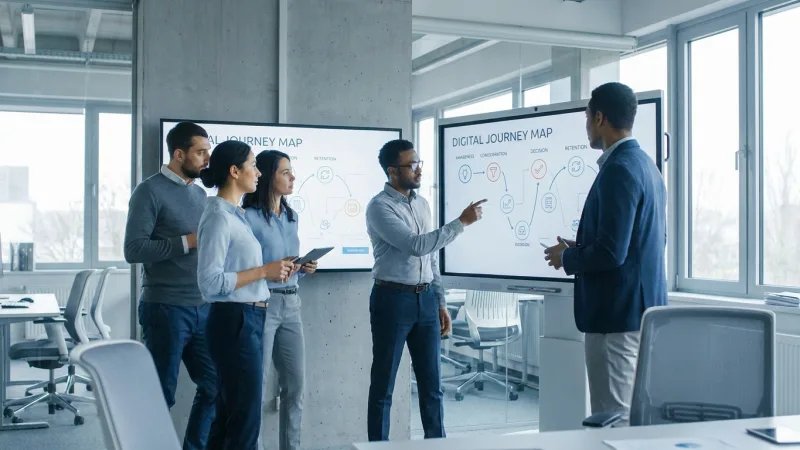
While B2C customers make individual purchase decisions in days or weeks, B2B buyers navigate a complex maze involving 6.8 decision-makers, 47+ touchpoints, and sales cycles averaging 9 months, yet most ‘customer journey mapping’ advice treats them exactly the same. This approach leads to revenue lost, time wasted, and competitors pulling ahead. Today, you’ll learn how to tackle these challenges head-on with a complete 5-step framework that turns your B2B customer journey mapping into a competitive advantage.
What is B2B Customer Journey Mapping (And Why It’s Nothing Like B2C)
B2B customer journey mapping is a strategic approach to understanding how businesses make purchase decisions. Unlike B2C, where decisions are often quick and individual, B2B journeys involve multiple decision-makers and require aligning several departments over an extended timeline. Traditional journey mapping often overlooks these nuances, treating complex B2B processes like simplified B2C paths.
Let’s break it down:
| Characteristic | B2B | B2C |
| decision-makers | 6.8 average | 1-2 individuals |
| Touchpoints | 47+ critical interactions | 10-15 touchpoints |
| Sales Cycle Length | Average 9 months | Days to weeks |
B2B complexities arise from these differences. Consider a software vendor: their product affects IT, finance, and end-users, each with distinct needs. This complexity requires a tailored approach, which most traditional mapping techniques fail to offer.
Such flaws are evident when mapping touchpoints. Traditional mapping overlooks critical B2B interactions like decision-makers meetings or inter-departmental discussions. This leads to an incomplete understanding, In the end, impacting conversion rates and customer retention.
The Multi-decision-makers Challenge: Mapping 6.8 Decision Makers Per B2B Purchase
Mapping a B2B journey means charting the influences of an average of 6.8 decision-makers per purchase. Each decision-makers type, from decision-makers to end-users, has unique needs and concerns that impact the buying journey.
Different decision-makers have different agendas. For example, while the finance team prioritizes budget alignment, IT focuses on integration and security. These individual journeys must intersect cohesively. In one case, a tech company’s purchasing decision involved the CFO, CTO, and department heads, each with separate journeys. Mapping these interactions revealed overlapping concerns, enabling the company to address them collectively and shorten their sales cycle by 30%.
Here’s a framework to visualize these complex paths:
| decision-makers | Primary Influence | Journey Intersection Point |
| Chief Finance Officer | Budget and cost | Final budget approval |
| Chief Technology Officer | Integration and security | Vendor evaluation |
| Department Heads | Operational impact | Solution testing |
By mapping the influences and intersection points of each decision-makers, you can tailor your approach to each group’s concerns while ensuring they align towards a shared purchase goal. This methodology directly improve conversion rates and boosts customer satisfaction.
The 7-Stage B2B Customer Journey Framework (Beyond Awareness-Consideration-Decision)
B2B sales cycles are neither linear nor simple. The 7-stage B2B customer journey framework accounts for these extended cycles, allowing marketers to strategically guide prospects from awareness to post-purchase expansion.
Here’s how it works:
- Problem Identification: Prospects first recognize a business need. This stage is important for understanding pain points and aligning your solutions to them.
- Solution Research: Buyers explore potential solutions. Providing high-value content like whitepapers or case studies can position your offering as a top choice.
- Vendor Evaluation: decision-makers compare vendors. Transparency in pricing and features can differentiate you here.
- decision-makers Alignment: Internal discussions occur to align all decision-makers. help this conversation through targeted messaging is important.
- Procurement Process: Formal negotiations start. A simplify procurement process can tip the scales in your favor.
- Implementation: After purchase, smooth onboarding becomes critical. Your support must ensure an easy transition.
- Expansion/Renewal: Focus shifts to long-term value and potential upsells. Consistent communication solidifies relationships and aids renewals.
Each stage encompasses multiple touchpoints, and failing to map them can leave gaps in your journey strategy. To dive deeper, consider downloading our detailed 7-Stage Framework with ROI Metrics, which provides precise tools to measure journey effectiveness.
Touchpoint Mapping for Complex B2B Environments: 47 Critical Interactions
B2B touchpoints extend far beyond traditional digital and physical interactions. With 47+ critical interactions, understanding and improve each touchpoint can greatly influence buying decisions.
Consider this complete touchpoint checklist:
| Category | Touchpoint | Description |
| Digital | Webinars | Interactive sessions to educate and engage decision-makers |
| Human | Sales meetings | Critical discussions shaping perceptions and decisions |
| Third-Party | Industry reviews | External validations influencing credibility |
| Internal | Cross-department meetings | Internal alignment on product needs and budgets |
Prioritizing these touchpoints requires a scoring system. High-impact interactions like sales meetings with decision-makers should be given higher priority, allowing you to allocate resources effectively and improve your impact on each part of the customer journey.
How to Create Your B2B Customer Journey Map: 8-Step Process
Crafting a B2B customer journey map involves meticulous planning. Here’s an 8-step process tailored for B2B complexities:
- Identify decision-makers: Recognize all decision-makers involved. Use decision-makers matrices to understand their roles and influences.
- Conduct Research: Gather data from various touchpoints like surveys and analytics to understand decision-makers needs.
- Data Collection: Collate information over the prolonged sales cycle to capture every important interaction.
- Visualize Journeys: Use tools to create visual maps that outline the steps and interactions in your journey.
- Collaborate Cross-Departmentally: Ensure all involved departments align on the journey goals and touchpoints.
- Integrate Feedback: Use feedback loops to refine your journey map continually.
- Implement and Test: Deploy the journey map in real scenarios and track its effectiveness.
- Iterate: Regularly update your map based on changing customer behaviors and market dynamics.
For a detailed step-by-step guide, download our 7-Step Framework. This resource will walk you through each stage with practical examples and tools.
B2B Journey improve: 12 High-Impact Improvements
Mapping is just the start. To truly excel, you must improve your B2B journey map for maximum impact. Here are 12 high-impact improvements to consider:
- Create decision-makers-Specific Content: Tailor content to address each decision-makers’s needs and concerns, increasing engagement.
- Eliminate Friction Points: Identify and simplify any obstacles within the journey that hinder progress.
- Improve Cross-Departmental Handoffs: Ensure smooth transitions between departments, reducing process delays.
- Measure and improve ROI: Deploy a strong analysis of journey effectiveness using ROI metrics.
- Personalize Communication: Use advanced data platforms to tailor communications to specific decision-makers.
- improve Onboarding Experience: Provide complete support during the implementation stage.
- Refine Value Propositions: Continuously update and refine your value propositions based on market and customer feedback.
- Engage Through Multiple Channels: use a mix of digital and physical channels for a complete reach.
- build Long-Term Relationships: Build on initial sales with consistent post-purchase engagement strategies.
- Incorporate Predictive Analytics: Use data to anticipate decision-makers needs and preemptively address them.
- use Social Proof: use testimonials and case studies to build trust with potential clients.
- Track Competition: Stay informed of competitor strategies and refine your approaches accordingly.
Prioritization is key. Use the improve priority matrix to determine which actions will yield the highest impact, and start implementing them today to see immediate improvements in your customer journeys.
Measuring B2B Journey Success: KPIs Beyond Conversion Rate
To accurately measure B2B journey success, relying solely on conversion rates is inadequate. Stage-specific metrics, decision-makers engagement scoring, and journey velocity are integral to tracking progress.
Consider these important metrics:
| Metric | Description |
| Stage-Specific Metrics | Evaluate effectiveness at each journey stage, from awareness to renewal. |
| decision-makers Engagement Scores | Assess how actively each decision-makers is involved and influenced. |
| Journey Velocity | Measure the time taken to move from one stage to another. |
| Cross-Departmental Impact | Track the influence of internal alignment on journey progression. |
use a B2B Journey Metrics Dashboard to monitor these KPIs effectively. This approach ensures your strategies remain responsive and improve for the complexities of B2B journeys.
Conclusion
Today, take the first step by mapping out your B2B customer journey using our 7-stage framework. Start by identifying key decision-makers and charting their unique paths. Dive deeper with resources on B2B retention and decision-makers management to amplify results. The future of B2B marketing lies in detailed journey mapping, those who master it will outpace competition and secure long-term success.
What is customer journey mapping? Customer journey mapping is a visual representation of a customer’s experience with a company. It outlines each touchpoint the customer encounters, helping businesses understand and improve the customer experience. How to create a B2B customer journey map? Start by identifying all decision-makers involved in the buying process. Gather data through surveys and analytics, then visually map the journey using a structured framework, ensuring cross-departmental collaboration for alignment. What’s the difference between B2B and B2C customer journey mapping? B2B customer journey mapping involves multiple decision-makers, longer sales cycles, and complex decision-making processes, whereas B2C focuses on shorter, individual consumer decisions. How long does a typical B2B customer journey take? The average B2B customer journey takes about 9 months, reflecting its complexity with multiple decision-makers and extended decision-making phases. What are the most important B2B customer journey touchpoints? Key B2B touchpoints include digital interactions like webinars, human interactions like sales meetings, third-party validations, and internal cross-departmental meetings, each influencing the buying decision.