
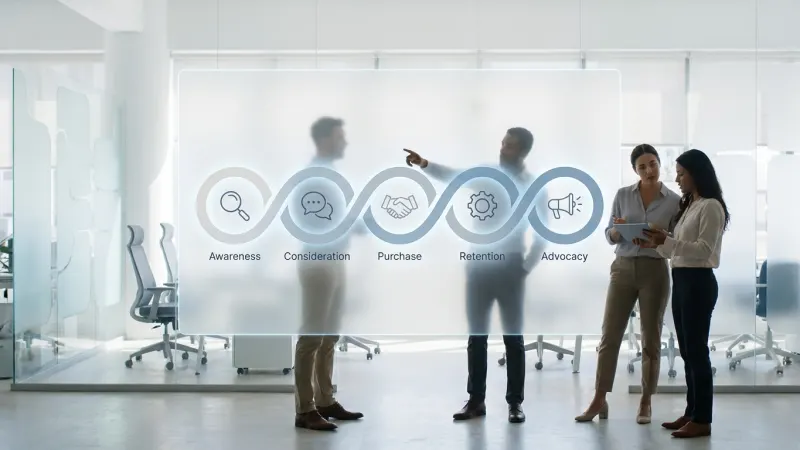
73% of B2B companies create customer journey maps, but only 23% use them to actually improve buyer experiences, here’s how to join the minority that drives measurable results. Customer journey mapping in B2B is not just about drawing lines from awareness to purchase. It’s about capturing and use insights that can cut acquisition costs by 30% and increase repeat purchase rates by 20%. In this guide, you’ll get a 5-step framework to map out the buyer path effectively and tactics to improve it for real impact. We’ll dive into strategic mapping frameworks, tactical improve techniques, and sprinkle in real B2B examples across different sales cycle lengths.
What is B2B Customer Journey Mapping (And Why 73% of Companies Get It Wrong)
Customer journey mapping for B2B isn’t a walk in the park. While 73% of companies attempt to map journeys, a staggering number fail to translate those maps into practical strategies. B2B customer journey mapping involves visualizing the end-to-end buyer path, from initial touchpoints to post-purchase experiences. However, many organizations miss key nuances that differentiate B2B from B2C journeys, leading to underwhelming ROI.
Common pitfalls include over-relying on assumptions, underestimating the complexity of B2B decision-making, and failing to integrate real customer feedback. For example, a company may invest in creating a detailed map but uses outdated data which results in a misalignment with current buyer behavior. Successful implementations, by contrast, have reported a 45% increase in customer satisfaction and a 30% faster sales cycle.
Unlike B2C, where decisions are often impulsive, B2B journeys are intricate, involving multiple decision-makers and extended timelines. For instance, purchasing decisions in B2B may involve an average of 6-10 decision-makers and can take anywhere from 3 to 24 months. Here’s a quick comparison of B2B vs B2C journey characteristics:
|
Aspect |
B2B Customer Journey |
B2C Customer Journey |
|
Decision Makers |
6-10 decision-makers |
Individual/Self |
|
Sales Cycle |
3-24 Months |
Instant to Weeks |
|
Touchpoints |
Multi-Channel, Complex |
Few, Simple |
|
Focus |
Value and ROI |
Emotion and Price |
To avoid the pitfalls, use a framework for identifying key decision makers versus mere influencers. This ensures your efforts are strategically aligned towards those who genuinely impact the purchasing decision.
The B2B Buyer Journey vs Customer Journey: Critical Distinctions That Impact Your Strategy
Grasping the difference between the B2B buyer journey and the customer journey is important. They may sound interchangeable, but strategically, they diverge significantly. The buyer journey primarily concerns itself with the pre-purchase phase, focusing on how prospects move from awareness to consideration and decision. Conversely, the customer journey spans the entire lifecycle, emphasizing post-purchase experiences, renewals, and advocacy.
During the pre-purchase phase, understanding decision-makers involvement is important. Only 50% of journey maps address the complexity of various influencers and decision-makers effectively. Measurement metrics also differ: while the buyer journey might focus on lead conversion rates, the customer journey should track customer satisfaction and lifetime value.
Resource allocation is another critical distinction. For example, sales teams are heavily involved in the buyer journey, while customer success teams take center stage in the customer journey. Here’s a side-by-side comparison of these processes:
|
Phase |
Buyer Journey |
Customer Journey |
|
Focus |
Pre-Purchase |
Post-Purchase |
|
Primary Metrics |
Lead Conversion, Cost per Lead |
Customer Satisfaction, Retention |
|
decision-makers |
Sales, Marketing |
Customer Success, Support |
|
Typical Duration |
3-24 Months |
1-5 Years |
Consider use a timeline framework to visualize overlap periods, ensuring no phase is neglected during mapping. A clear delineation between these phases aids in smooth strategy execution and measurable success.
B2B Customer Journeys in 2024: New Patterns, Digital Touchpoints, and Hybrid Buying Behaviors
The market of B2B customer journeys is shifting at a rapid pace, especially post-pandemic. The rise of remote decision-making has notably altered buying patterns. A recent survey showed that 67% of B2B buyers prefer self-service portals over interacting with sales reps. This means that digital touchpoints have gained increased importance, but are you prioritizing the right ones?
In 2024, buyers expect smooth digital experiences that allow them to gather the information they need independently. The timeline expectations have also changed. Buyers now anticipate shorter decision-making periods due to improved access to data and peer reviews.
Let’s break down the behavior with a statistics table:
|
Behavioral Change |
Statistics |
|
Preference for Self-Service |
67% of Buyers |
|
Decision-Making Timeline |
Shortened by 25% |
|
Digital Research |
80% Start Online |
|
In-Person Meetings |
Reduced by 40% |
To adapt, companies must improve their digital touchpoint experiences, ensuring strong content that guides buyers swiftly through the decision-making process. Consider adopting new technologies to better help these interactions, such as improve CRM systems. For assistance, check out our HubSpot vs Marketo vs Pardot comparison.
The 7-Step B2B Journey Mapping Framework: From decision-makers Research to improve
Ready to build a strong B2B customer journey map? Here’s the 7-step framework that covers everything from initial research to practical improve:
- decision-makers Identification and Persona Development: Map out the key decision-makers and influencers. Develop detailed personas to understand their motivations and pain points.
- Touchpoint Inventory and Categorization: List all customer touchpoints, categorizing them by their role in the customer journey.
- Pain Point and Moment of Truth Identification: Pinpoint critical moments that influence decision-making and customer satisfaction.
- improve Opportunity Scoring: Evaluate each touchpoint for improvement potential.
- Touchpoint Audit: Assess the effectiveness of current touchpoints and identify gaps.
- Implement Technology Solutions: use a tech stack that supports journey mapping and improve. Consider our guide on building a functional MarTech stack.
- Continuous Monitoring and Iteration: Establish KPIs and review them regularly to ensure ongoing improve.
Here’s a process checklist to ensure you’re on track:
|
Step |
Action |
Status |
|
1 |
Identify Decision Makers |
|
|
2 |
Conduct Persona Workshops |
|
|
3 |
Map Initial Touchpoints |
|
|
4 |
Evaluate Touchpoint Effectiveness |
|
|
5 |
Conduct a Touchpoint Audit |
|
|
6 |
Implement CRM Tools |
|
|
7 |
Review KPIs Monthly |
Advanced Touchpoint Mapping: Multi-Channel Attribution and Cross-Functional Alignment
Mapping touchpoints in B2B isn’t just a task; it’s a technical endeavor requiring precise execution. Multi-channel attribution is important, as it enables you to analyze where the value truly comes from, across a typically long sales cycle. Here’s how to execute this at scale:
Integrate your technology stack to track interactions smooth. This requires cross-departmental alignment to ensure data flows without silos. An effective framework for this includes a RACI matrix to outline responsibilities across teams, ensuring everyone knows their role in the mapping process.
An attribution model comparison table below can aid in selecting the right approach for your business:
|
Model |
Best For |
Considerations |
|
First-Touch Attribution |
Single-Channel Initiatives |
Overemphasizes initial contact |
|
Last-Touch Attribution |
Conversion-Focused Campaigns |
Ignores customer journey context |
|
Multi-Touch Attribution |
Complex, Multi-Channel Journeys |
Requires advanced analytics |
Effective data collection is key. Regularly analyze journey data to identify improve opportunities. If you’re looking to refine your approach, consider our cookieless programmatic advertising guide for insights into advanced tracking methods.
Measuring and improve B2B Customer Experience: KPIs, Testing, and Continuous Improvement
Getting your customer journey mapping to drive real results isn’t just about setup; it’s about ongoing improve. Define clear KPIs that align with your business goals. For journey-specific KPIs, focus on metrics like Net Promoter Score (NPS), Customer Satisfaction (CSAT), and churn rates.
Incorporate A/B testing methodologies to identify improvements for each touchpoint. This could mean tweaking landing page content or adjusting email sequences based on test results. Use an improve prioritization framework to focus efforts where they’ll have the greatest impact.
For ROI calculations, map the impact of each touchpoint on revenue. A worksheet calculating potential ROI for improvements can clarify the financial benefits of improve efforts. Here’s a sample KPI dashboard template:
|
KPI |
Target |
Actual |
|
Net Promoter Score |
70 |
65 |
|
Customer Satisfaction |
90% |
88% |
|
Churn Rate |
5% |
4.5% |
Continuous improvement is not an option; it’s a necessity. Regularly revisit your journey map, ensuring it adapts to changes in buyer behavior and market conditions. Explore our marketing ROI framework for more on securing buy-in for iterative improvements.
Real B2B Journey Mapping Examples: SaaS, Manufacturing, and Professional Services Case Studies
Seeing is believing, and nothing beats real-world examples to grasp the power of effective B2B customer journey mapping. Let’s explore three industry-specific cases:
SaaS Freemium to Enterprise Journey: A SaaS company offering a freemium model found that 75% of their enterprise conversions stemmed from users who had heavily engaged with educational content. By improve these touchpoints, they increased enterprise sales by 15%. The key was a targeted content strategy that transitioned users smoothly from freemium to paid tiers.
Manufacturing Long-Cycle Procurement Journey: In manufacturing, the procurement process can span up to 24 months. Addressing this, a company introduced quarterly feedback loops, reducing cycle time by 20%. By focusing on relationship management, they improved retention rates significantly by introducing personalized touchpoints for key accounts.
Professional Services Relationship-Based Journey: For a professional services firm, the journey doesn’t end at purchase. They improve customer satisfaction by implementing post-purchase review mechanisms, leading to a 30% increase in referral business. The focus here was on continuous engagement through regular check-ins and value-driven content sharing.
These examples underscore the importance of tailoring journey maps to industry-specific nuances and use data-driven insights to fuel growth. Dive deeper into strategic insights with our Account-Based Marketing guide for ROI-driven strategies.
Conclusion
The real power of B2B customer journey mapping lies in its ability to change insights into practical strategies that boost your bottom line. Start by reviewing your existing maps today and see where you can integrate or improve digital touchpoints. Focus on aligning cross-functional teams to ensure a smooth execution of your journey maps. Ready to improve? Consider your next step to be a deep dive into our Ultimate Guide to Marketing Automation to support your journey mapping initiatives with modern tools.
What is customer journey mapping?
Customer journey mapping is the process of creating a visual representation of the customer’s interactions with a business. It helps identify touchpoints, pain points, and opportunities to improve the customer experience. By understanding these elements, companies can improve their service and engagement strategies effectively.
How to create a B2B customer journey map?
To create a B2B customer journey map, start by identifying key decision-makers and developing buyer personas. Then, map out all potential touchpoints, categorize them, and identify pain points. Use this data to improve each touchpoint, integrate technology for tracking, and continuously refine the map based on performance insights.
What’s the difference between B2B and B2C customer journey mapping?
B2B journey mapping involves multiple decision-makers, longer sales cycles, and a focus on value and ROI. In contrast, B2C mapping typically involves individual decision-making with a shorter cycle, emphasizing emotional engagement and price sensitivity.
How long does it take to create a B2B customer journey map?
Creating a B2B customer journey map can take anywhere from several weeks to a few months. The timeframe depends on the complexity of your sales process, the number of decision-makers involved, and how complete you aim for the map to be. Continuous refinement is also important post-creation.
What tools are best for B2B customer journey mapping?
Tools like CRM systems (e.g., Salesforce, HubSpot), marketing automation platforms, and analytics software are best for B2B customer journey mapping. These tools help centralize data, track interactions, and help a smooth mapping process. Explore our CRM and marketing automation guide for more details.