
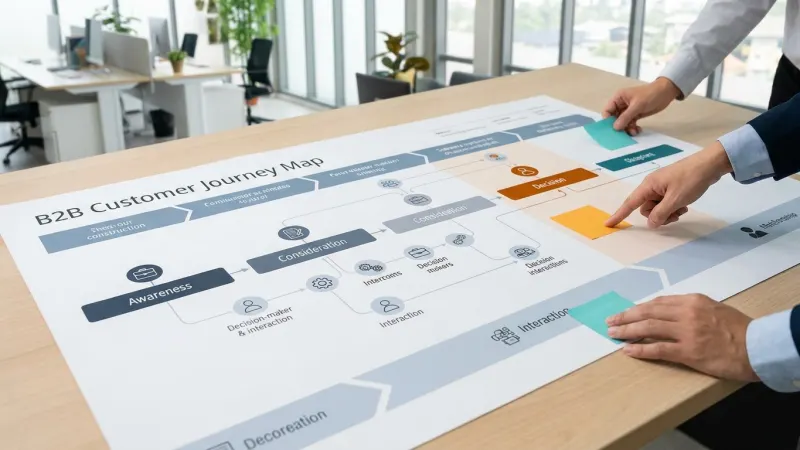
73% of B2B companies think they’re mapping customer journeys, but they’re actually just creating buyer personas, and it’s costing them millions in lost revenue. Imagine the revenue lost because these companies aren’t improve at each important stage. If you’re tired of watching competitors pull away with better conversion rates, you’re in the right place. By the end of this article, you’ll have a 6-step framework for mapping your B2B customer journey that’s directly linked to increasing conversions by up to 40%. This isn’t theoretical fluff; this is about measurable, ROI-focused results that will change your sales cycle.
The B2B Customer Journey Crisis: Why 73% of Companies Map Incorrectly
Let’s get straight to the heart of the matter: 73% of B2B companies are misinterpreting customer journey mapping as mere buyer persona creation. The problem? Buyer journeys are dynamic, involving multiple touchpoints over extended periods, unlike static personas. On average, a B2B sales cycle spans 18 months and requires over eight interactions before a deal closes.
Companies with accurate journey mapping can boost their conversion rates by 40%. This is because they identify revenue-impacting touchpoints and improve them, whereas others are stuck on generic personas that offer no tactical guidance.
| Mapping Approach | Conversion Rate | Revenue Impact |
| Buyer Persona Only | 10% | $100K (example) |
| Full Journey Mapping | 14% | $140K (example) |
Common mapping mistakes include skipping critical touchpoints and failing to align content to specific buying stages. The best approach is to use a structured framework to identify, map, and improve these stages. Consider integrating your customer journey mapping with an effective CRM marketing automation system to simplify the process.
B2B vs B2C Journey Mapping: The 5 Critical Differences That Change Everything
Assuming B2B and B2C journey maps are similar is a mistake that leads to inefficiencies. B2B journeys are characterized by a complex Decision-Making Unit (DMU) rather than a single buyer. These processes are driven by rational needs and extended timelines, often involving multiple decision-makers across departments.
| Aspect | B2C | B2B |
| Decision Maker | Individual | Multiple decision-makers |
| Triggers | Emotional | Rational |
| Timeline | Short | Extended |
| Touchpoints | Simple | Complex |
With the added layer of complexity, B2B marketers must prioritize touchpoints by identifying those specific to decision group dynamics. Use the 7-step framework to address these unique B2B challenges effectively.
The IMPACT Framework: 6-Stage B2B Journey Mapping Methodology
To gain precise control over your customer journey mapping, apply the IMPACT framework. This six-stage methodology offers a systematic way to visualize and improve your buyer path, ensuring each stage contributes to revenue goals:
- Identify decision-makers and Roles: Understand all decision-makers involved, from initiators to gatekeepers.
- Map Current State Touchpoints: Document each interaction from initial awareness to post-purchase.
- Prioritize Pain Points by Revenue Impact: Identify and fix touchpoints where the most revenue is lost.
- Align Content to Buying Stages: Ensure your content strategy supports each stage of the buyer’s journey.
- Create improve Experiments: Develop hypotheses and test new approaches for existing touchpoints.
- Track Conversion Metrics: Monitor improvements using KPIs that reflect journey efficiency.
The IMPACT framework is about practical steps that directly affect bottom-line results. For more on strategic alignment in B2B marketing, check the ABM ROI framework.
Touchpoint Mapping: The 23 Critical B2B Customer Interactions You’re Missing
In B2B environments, not all touchpoints are obvious. Many go unnoticed, leading to missed opportunities. From pre-awareness phases where prospects conduct initial research, to post-purchase interactions that can lead to customer expansion, identifying these is important.
Consider a touchpoint audit to ensure you’re not missing any key interactions:
| Touchpoint Category | Examples of Critical Interactions |
| Pre-Awareness | Industry webinars, LinkedIn group discussions |
| Awareness | Email campaigns, targeted ads |
| Consideration | Whitepapers, product demos |
| Decision | Customer testimonials, live chat support |
| Post-Purchase | Onboarding sessions, NPS surveys |
Use these to fine-tune your strategy and boost conversion rates. Assess these interactions through a 5-step journey mapping framework for complete insights.
Journey Mapping Tools and Templates: Build Your First Map in 2 Hours
Building your B2B customer journey map doesn’t have to be a lengthy process. Using the right tools, you can construct an insightful map quickly. Here’s how free and paid options stack up:
| Tool | Type | Pricing | Special Features |
| Lucidchart | Paid | $7.95 per user/month | Real-time collaboration, templates |
| Google Drawings | Free | $0 | Easy integration with Google Workspace |
To fast-track your journey mapping, download our customizable template that caters to different B2B industries. Organize a collaborative workshop with your team to gather input and drive alignment.
improve Strategies: 12 Proven Tactics to Reduce Sales Cycle by 30%
Once you’ve mapped the journey, the next step is improve. These 12 tactics will help reduce your sales cycle by up to 30%:
- Identify content gaps and develop resources to fill them.
- simplify onboarding processes to improve initial user experience.
- Implement account-based marketing for targeted engagement.
- improve personalization with data-driven insights.
- Reduce friction by simplifying purchase processes.
- Schedule regular reviews of sales funnel effectiveness.
- use retargeting strategies to engage lapsed leads.
- Automate repetitive tasks to free up sales personnel.
- build cross-departmental communication for better alignment.
- use peer testimonials to reduce buyer hesitation.
- improve for mobile-first interactions to improve accessibility.
- Experiment with different communication channels for outreach.
For more strategies, discover how retargeting can increase conversions by 40%.
Measuring Journey Map ROI: KPIs and Metrics That Matter to Revenue
Measurement is important. To quantify the ROI of your journey mapping efforts, focus on these KPIs:
- Conversion Rate
- Average Deal Size
- Sales Cycle Length
- Customer Lifetime Value
- Churn Rate
Use leading indicators like touchpoint effectiveness and lagging indicators such as revenue to guide your strategy. Set up an attribution model that assigns credit across multiple interactions, ensuring no touchpoint is undervalued. Use our ROI calculation framework to simplify the process.
To cement your findings, create a dashboard that allows real-time tracking and assessment of these metrics, driving continuous improvement.
Conclusion
Start mapping your customer journey today with the IMPACT framework. This is the practical solution to make your B2B sales more efficient and profitable. For further insights on refining your buyer path, explore our guide on visualizing and improving the buyer path. As the B2B market evolves, those who adapt their journey mapping strategies will lead the charge in market share and profitability.
What is customer journey mapping in B2B? Customer journey mapping in B2B is the process of visualizing the end-to-end experience of a customer interacting with a company. Unlike B2C, B2B involves multiple decision-makers, and mapping captures all touchpoints, from awareness to post-purchase, to improve customer experience and drive sales. How to create a B2B customer journey map? Start by identifying all key decision-makers involved in purchasing decisions. Map out each touchpoint they encounter, prioritize those that impact revenue, and align content to support each stage of the buyer’s journey. Use tools and templates to visualize and refine the process. How long does B2B customer journey mapping take? Initial mapping can be completed within a few days to weeks, depending on complexity. Implementing and improve the map is an ongoing process that requires regular updates as markets and customer behaviors change. What tools are best for B2B customer journey mapping? Tools like Lucidchart offer paid options with strong features, while Google Drawings provides a cost-effective alternative. The choice depends on your specific needs, such as real-time collaboration or integration with existing tools.