
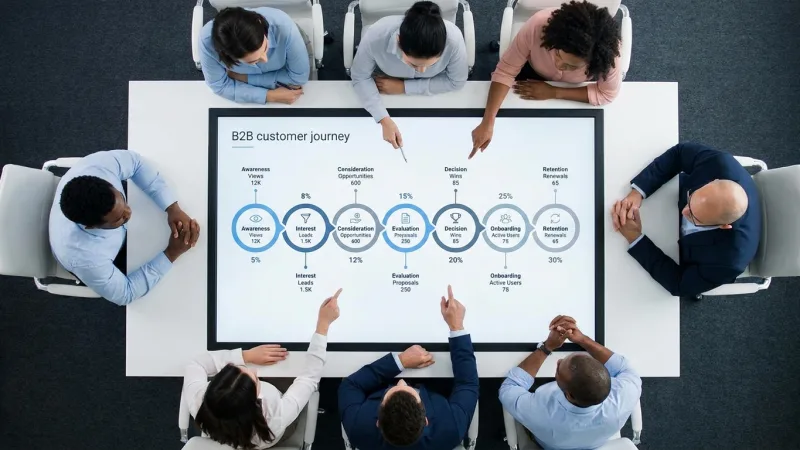
73% of B2B buyers report feeling frustrated by disconnected experiences across touchpoints, yet only 23% of companies have mapped their complete customer journey to revenue outcomes. This disconnect often results in missed opportunities and a weakened competitive edge. In this article, you’ll discover how to bridge this gap with a strong customer journey mapping B2B framework that directly ties each touchpoint to pipeline metrics and ROI. By the end, you’ll have a 5-step framework to map your customer journey effectively.
What Is B2B Customer Journey Mapping (And Why It’s Different from B2C)
B2B customer journey mapping is not your typical consumer pathway. It involves a multifaceted approach due to longer sales cycles, numerous decision-makers, and complex solutions. Unlike B2C journeys where purchase decisions often rest with individual emotions and impulses, B2B decisions involve buying committees averaging 6.8 people. These committees require targeted touchpoints at various stages to steer their decision-making process effectively.
The complexity lies in the path: a B2B journey isn’t a sprint but a marathon, influenced by factors like industry regulations and budget cycles. In B2C, decision-making is linear, while B2B paths often loop back at various stages, requiring a tailored approach. Consider this: the average B2B buyer’s journey lasts 6-12 months, compared to 5-10 weeks in B2C.
| Aspect | B2B Journey | B2C Journey |
| Decision Makers | 6.8 on average | 1-2 individuals |
| Sales Cycle | 6-12 months | 5-10 weeks |
| Focus | Account-based | Individual-based |
For B2B marketers, understanding these nuances is critical. To reap the benefits of mapping, it’s important to not just track the journey but also connect it with measurable outcomes. For a deeper dive, explore this 7-Stage Framework for Complex Sales.
The Revenue Impact Framework: Connecting Journey Stages to Pipeline Metrics
Mapping customer journey stages to revenue outcomes isn’t just strategic, it’s important. The revenue impact framework focuses on making each journey phase accountable to pipeline metrics. For example, tracking conversion rates from awareness to consideration stages can spotlight where prospects are dropping off, allowing you to address these leaks directly.
Consider the following conversion rate benchmarks for each phase of the B2B customer journey:
| Journey Stage | Benchmark Conversion Rate |
| Awareness | 2-5% |
| Consideration | 5-10% |
| Decision | 10-20% |
By improve each stage, you can improve pipeline velocity, a measure of how quickly leads move through your sales funnel. Reducing cost per acquisition by 30% can be achieved by aligning your touchpoints with revenue impact. For further insights, check out our framework that boosts win rates by 18%.
The 7-Stage B2B Customer Journey Model (With Touchpoint Examples)
The most effective B2B customer journeys are those that are comprehensively mapped from problem awareness to advocacy. Each stage includes specific touchpoints that align with the buyer’s mindset, help a smooth transition through the journey.
Here’s a breakdown of the 7-stage B2B journey model:
- Problem Awareness: use content that educates about industry issues. Touchpoints include blogs and social media posts.
- Research: Help prospects look deeper. Offer whitepapers and webinars to showcase expertise.
- Consideration: Engage with personalized emails and case studies to highlight solutions.
- Decision: Provide detailed proposals and one-on-one consultations.
- Purchase: Smooth onboarding processes and immediate support can improve experience.
- Post-Purchase: build loyalty with customer success programs and feedback loops.
- Advocacy: Encourage referrals through review campaigns and loyalty rewards.
Mapping these touchpoints effectively requires a strategic retargeting strategy that accounts for each channel and audience segment.
Step-by-Step B2B Journey Mapping Process (With Templates)
Creating a B2B journey map is a meticulous process that demands strategic planning and execution. Here’s an 8-step implementation guide:
- Define Objectives: Establish what you aim to achieve with your mapping, be it improving conversion rates or reducing churn.
- Research and Data Collection: Gather quantitative data from CRM systems and qualitative insights from customer interviews.
- Identify Personas: Use data to create detailed buyer personas that guide your touchpoint design.
- Map the Current Journey: Visualize existing touchpoints to understand current buyer interactions.
- Analyze Gaps: Identify and prioritize areas for improvement based on data-driven insights.
- Design the Future Journey: Create a revised journey map with improve touchpoints and interactions.
- Validate and Iterate: Test your map with real customers and refine based on feedback.
- Implement and Monitor: Roll out changes with the backing of strong analytics to track performance.
For more on data collection methods, see our CDP Guide.
Advanced Touchpoint Analysis: Digital and Human Interactions
Understanding the nuances of digital versus human touchpoints is important for journey improve. Conducting a thorough touchpoint audit can reveal where digital efficiency meets personal engagement.
A digital touchpoint audit might include assessing website conversion rates, email open rates, and social media interactions. Meanwhile, improve human interactions focuses on improving customer service quality and sales team training, as these often make the decisive difference in B2B sales.
| Aspect | Digital Interaction | Human Interaction |
| Measurement | Click-through rates, session duration | Customer satisfaction scores |
| improve | SEO, UX/UI improvements | Training, personalized communication |
Successful omnichannel experience design requires blending these interactions smooth. For insights, explore our cookieless advertising strategy.
Journey improve Strategies: From Insights to Action
Once your journey map is laid out, the next step is improve. Quick wins, such as improving landing page load times, can yield immediate results. In contrast, long-term improvements like CRM upgrades require a strategic roadmap.
Implement a gap analysis to prioritize actions. For instance, analyze where customer drop-off rates are highest, then align technology and team frameworks to address the identified gaps.
| Priority | Action | Expected Outcome |
| High | Revamp onboarding process | Reduce churn by 15% |
| Medium | improve email personalization | Boost open rates by 20% |
| Low | Increase blog frequency | Improve SEO ranking |
For a detailed roadmap, refer to our B2B retention strategies.
Measuring Success: KPIs and Analytics for B2B Journey Performance
The final piece of the puzzle is measuring the success of your B2B customer journey through precise KPIs and analytics. Key performance indicators should be specific to each journey stage and align with business objectives.
For instance, during the awareness stage, track metrics like website traffic growth and content engagement rates. In contrast, the decision phase may focus on lead-to-opportunity conversion rates.
| Journey Stage | Key KPIs |
| Awareness | Website traffic, bounce rate |
| Consideration | Engagement rates, session duration |
| Decision | Conversion rates, proposal acceptance |
For complete KPI frameworks, our B2B messaging frameworks offer valuable insights.
Conclusion
Start mapping your B2B customer journey today, aligning each stage with pipeline metrics to drive measurable business outcomes. use these insights to refine your strategy, adapt to the ever-evolving B2B market, and outpace competitors. For further guidance, explore our resources on complex sales journey mapping and CDP implementation. The future of B2B sales is interconnected, and your journey map can be the blueprint for success.
What is customer journey mapping? Customer journey mapping is the visualization of the steps a customer takes from problem awareness to brand advocacy. In B2B, this involves multiple decision-makers and longer sales cycles, requiring detailed mapping to ensure smooth experiences and better revenue outcomes. How to create a B2B customer journey map? Start with defining objectives and gathering data through research and interviews. Map the current journey, identify gaps, design a future state, validate changes, and monitor performance. Use templates and tools to refine and simplify the process for optimal results. What is the difference between a customer journey and a buyer journey? A customer journey encompasses all interactions from initial contact to post-purchase experiences, while a buyer journey focuses primarily on the decision-making process leading to purchase. In B2B, understanding both is important for complete mapping. How long does B2B customer journey mapping take? The duration varies, typically ranging from a few weeks to several months, depending on the complexity of the journey and the organization’s resources. It involves data collection, analysis, and iterative design to ensure accuracy and efficacy. What tools are best for B2B customer journey mapping? Tools like CRM platforms, analytics software, and visualization tools (e.g., Lucidchart) are important. They help in capturing data, analyzing touchpoints, and visualizing the customer journey accurately to help informed decision-making and strategy development.